Adam Bennett and Billie Acosta, after many years of teaching ethics in primary schools, have finally graduated to teaching high school ethics.
Billie and Adam have both taught ethics to their own children for over seven years, teaching all stages at primary school as their kids grew up. This year, they began teaching ethics at Smith’s Hill High School in Wollongong. Both have children at the school and in 2024 the school began offering ethics to year 7 and 8 students for the first time.
'More challenging...'
I’ve certainly appreciated the evolution of responses from the students when it comes to teaching high school ethics.

Adam Bennett has always enjoyed teaching ethics but was a little nervous about high school classes. “Even the most engaged children can become more challenging as they get older.”
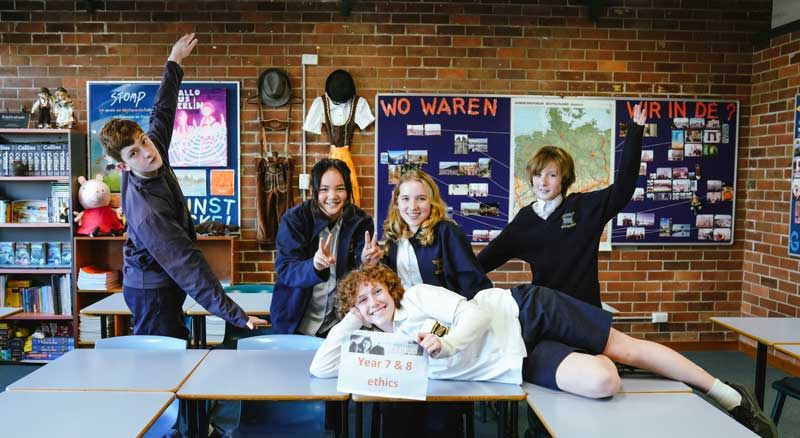
Both teachers notice that there seems to be an implicit consensus among the students that the point of ethics classes is to argue. The year 7 and 8 students seem to enjoy verbal sparring, as they debate their points of view. But with occasional reminders of the guidelines for healthy discussion, they do respectfully disagree, giving reasons and examples.
Billie Acosta has noticed that building on others’ points remains a popular strategy for Stage 4 classes, which discuss topics such as the environment and custodianship vs. ownership, politics and the media, social and cultural responsibility, human longevity and how it affects society, mindful communication and respect, among others. However, not all topics receive rave reviews from the students. As Billie recounted, “If you’re a fan of the pithy response, I offer you this from one of our students after one lesson – ‘some topics have overstayed their welcome!’ I don’t disagree.”
Is this the age where it happens and we, as ethics teachers, get to witness it first hand?
Both Adam and Billie find that the new discussion moves serve as a crucial fallback when organic debate is not flowing freely, but timing can be very important. Guiding the class in this way is not always aligned with class feeling about the topic and can as easily stall the conversation as prompt fresh ideas. One of the main aims is to make sure the lesson continues to be a safe space: students are safe to disagree, provide their reasons and to express their point of view. Arguing for one side of an issue or another is an important element of the class, which many of the students may have learned from primary school, and it can be challenging to keep some students from arguing all possible angles of a given question.

We realise there’s a need for curriculum and lesson plans but sometimes this may not leave the time or scope to tease out nuances in a particular discussion. Obviously, the demographic plays a part in student responses and Smiths’ Hill is certainly a specific demographic, as an academically selective school. Watching the students subconsciously sort through the issues and build on or try to refute each other’s ideas remains hugely satisfying. Occasionally, however, the discussion grinds to a halt.
Adam and Billy say: “As teachers, during these ‘brick wall conversations’ we often learn some interesting new slang and sometimes a little more about our students and the culture they live in. Sometimes we get stuck here and have to limp back to our questions and discussion moves, to get things moving again. Sometimes, the students surprise us with their lateral thinking and this level of understanding leads to a whole new class of ethical discussion.”
Adam and Billy agree: “Teaching ethics is a rewarding way to help children become skilled critical thinkers, able to identify and evaluate different opinions, formulate cogent arguments and disagree respectfully, as well as learning from each other.
Although we got involved to teach our own kids, even after 7+ years, teaching ethics is still great fun and we’d recommend it to anyone!”